Loading...
Searching...
No Matches
pip._vendor.cachecontrol.controller Namespace Reference
Data Structures | |
| class | CacheController |
Functions | |
| parse_uri (uri) | |
Variables | |
| logger = logging.getLogger(__name__) | |
| URI = re.compile(r"^(([^:/?#]+):)?(//([^/?#]*))?([^?#]*)(\?([^#]*))?(#(.*))?") | |
| tuple | PERMANENT_REDIRECT_STATUSES = (301, 308) |
Detailed Description
The httplib2 algorithms ported for use with requests.
Function Documentation
◆ parse_uri()
| parse_uri | ( | uri | ) |
Parses a URI using the regex given in Appendix B of RFC 3986.

(scheme, authority, path, query, fragment) = parse_uri(uri)
Definition at line 27 of file controller.py.
27def parse_uri(uri):
28 """Parses a URI using the regex given in Appendix B of RFC 3986.
29
30 (scheme, authority, path, query, fragment) = parse_uri(uri)
31 """
32 groups = URI.match(uri).groups()
33 return (groups[1], groups[3], groups[4], groups[6], groups[8])
34
35
References i.
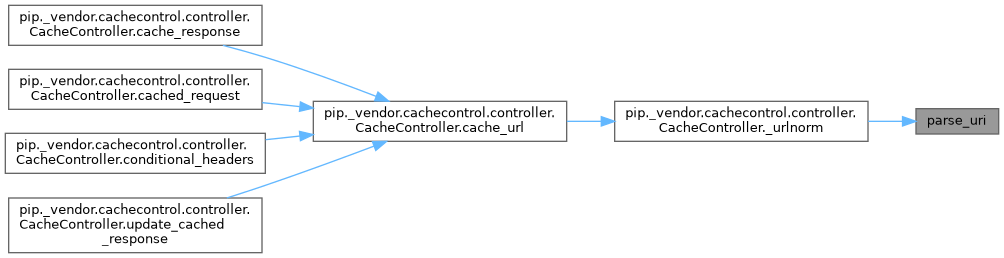
Referenced by CacheController._urlnorm().
Here is the caller graph for this function:
Variable Documentation
◆ logger
| logger = logging.getLogger(__name__) |
Definition at line 20 of file controller.py.
◆ PERMANENT_REDIRECT_STATUSES
| tuple PERMANENT_REDIRECT_STATUSES = (301, 308) |
Definition at line 24 of file controller.py.
◆ URI
| URI = re.compile(r"^(([^:/?#]+):)?(//([^/?#]*))?([^?#]*)(\?([^#]*))?(#(.*))?") |
Definition at line 22 of file controller.py.