Data Structures | |
| class | Capture |
| class | CaptureError |
| class | Console |
| class | ConsoleDimensions |
| class | ConsoleOptions |
| class | ConsoleRenderable |
| class | ConsoleThreadLocals |
| class | Group |
| class | NewLine |
| class | NoChange |
| class | PagerContext |
| class | RenderHook |
| class | RichCast |
| class | ScreenContext |
| class | ScreenUpdate |
| class | ThemeContext |
Functions | |
| Callable[..., Callable[..., Group]] | group (bool fit=True) |
| bool | _is_jupyter () |
| "WindowsConsoleFeatures" | get_windows_console_features () |
| bool | detect_legacy_windows () |
| str | _svg_hash (str svg_main_code) |
Variables | |
| int | JUPYTER_DEFAULT_COLUMNS = 115 |
| int | JUPYTER_DEFAULT_LINES = 100 |
| str | WINDOWS = "Windows" |
| HighlighterType = Callable[[Union[str, "Text"]], "Text"] | |
| JustifyMethod = Literal["default", "left", "center", "right", "full"] | |
| OverflowMethod = Literal["fold", "crop", "ellipsis", "ignore"] | |
| NO_CHANGE = NoChange() | |
| _STDIN_FILENO = sys.__stdin__.fileno() | |
| _STDOUT_FILENO = sys.__stdout__.fileno() | |
| _STDERR_FILENO = sys.__stderr__.fileno() | |
| tuple | _STD_STREAMS = (_STDIN_FILENO, _STDOUT_FILENO, _STDERR_FILENO) |
| tuple | _STD_STREAMS_OUTPUT = (_STDOUT_FILENO, _STDERR_FILENO) |
| dict | _TERM_COLORS |
| RenderableType = Union[ConsoleRenderable, RichCast, str] | |
| RenderResult = Iterable[Union[RenderableType, Segment]] | |
| _null_highlighter = NullHighlighter() | |
| dict | COLOR_SYSTEMS |
| dict | _COLOR_SYSTEMS_NAMES = {system: name for name, system in COLOR_SYSTEMS.items()} |
| console = Console(record=True) | |
Function Documentation
◆ _is_jupyter()
|
protected |
Check if we're running in a Jupyter notebook.
Definition at line 517 of file console.py.
References i.
◆ _svg_hash()
|
protected |
Returns a unique hash for the given SVG main code.

Args:
    svg_main_code (str): The content we're going to inject in the SVG envelope.

Returns:
    str: a hash of the given content
Definition at line 2568 of file console.py.
References i.
◆ detect_legacy_windows()
| bool detect_legacy_windows | ( | ) |
Detect legacy Windows.
Definition at line 588 of file console.py.
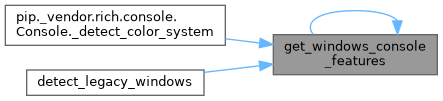
References pip._vendor.rich.console.get_windows_console_features().

◆ get_windows_console_features()
| "WindowsConsoleFeatures" get_windows_console_features | ( | ) |
Definition at line 578 of file console.py.
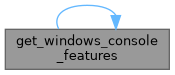
References pip._vendor.rich.console.get_windows_console_features().
Referenced by Console._detect_color_system(), pip._vendor.rich.console.detect_legacy_windows(), and pip._vendor.rich.console.get_windows_console_features().
◆ group()
| Callable[..., Callable[..., Group]] group | ( | bool | fit = True | ) |
A decorator that turns an iterable of renderables in to a group.

Args:
    fit (bool, optional): Fit dimension of group to contents, or fill available space. Defaults to True.
Definition at line 495 of file console.py.
Variable Documentation
◆ _COLOR_SYSTEMS_NAMES
Definition at line 544 of file console.py.
◆ _null_highlighter
|
protected |
Definition at line 285 of file console.py.
◆ _STD_STREAMS
|
protected |
Definition at line 105 of file console.py.
◆ _STD_STREAMS_OUTPUT
|
protected |
Definition at line 106 of file console.py.
◆ _STDERR_FILENO
|
protected |
Definition at line 101 of file console.py.
◆ _STDIN_FILENO
|
protected |
Definition at line 93 of file console.py.
◆ _STDOUT_FILENO
|
protected |
Definition at line 97 of file console.py.
◆ _TERM_COLORS
|
protected |
Definition at line 109 of file console.py.
◆ COLOR_SYSTEMS
| dict COLOR_SYSTEMS |
Definition at line 537 of file console.py.
◆ console
| console = Console(record=True) |
Definition at line 2581 of file console.py.
◆ HighlighterType
| HighlighterType = Callable[[Union[str, "Text"]], "Text"] |
Definition at line 81 of file console.py.
◆ JUPYTER_DEFAULT_COLUMNS
| int JUPYTER_DEFAULT_COLUMNS = 115 |
Definition at line 77 of file console.py.
◆ JUPYTER_DEFAULT_LINES
| int JUPYTER_DEFAULT_LINES = 100 |
Definition at line 78 of file console.py.
◆ JustifyMethod
| JustifyMethod = Literal["default", "left", "center", "right", "full"] |
Definition at line 82 of file console.py.
◆ NO_CHANGE
| NO_CHANGE = NoChange() |
Definition at line 90 of file console.py.
◆ OverflowMethod
| OverflowMethod = Literal["fold", "crop", "ellipsis", "ignore"] |
Definition at line 83 of file console.py.
◆ RenderableType
| RenderableType = Union[ConsoleRenderable, RichCast, str] |
Definition at line 280 of file console.py.
◆ RenderResult
| RenderResult = Iterable[Union[RenderableType, Segment]] |
Definition at line 283 of file console.py.
◆ WINDOWS
| str WINDOWS = "Windows" |
Definition at line 79 of file console.py.