Public Member Functions | |
| None | __init__ (self, str gotten_hash) |
| str | body (self) |
 Public Member Functions inherited from HashError Public Member Functions inherited from HashError | |
| str | __str__ (self) |
Data Fields | |
| gotten_hash | |
| req | |
| Data Fields inherited from HashError | |
| req | |
Static Public Attributes | |
| int | order = 2 |
| tuple | head |
| Static Public Attributes inherited from HashError | |
| Optional | req = None |
| str | head = "" |
| int | order = -1 |
Additional Inherited Members | |
| Protected Member Functions inherited from HashError | |
| str | _requirement_name (self) |
Detailed Description
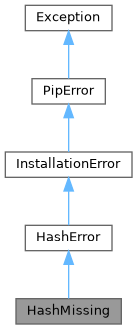
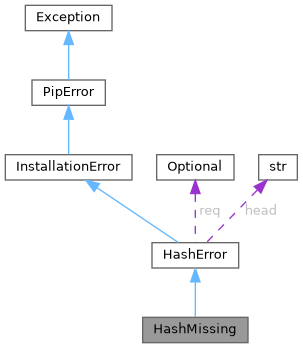
A hash was needed for a requirement but is absent.
Definition at line 515 of file exceptions.py.
Constructor & Destructor Documentation
◆ __init__()
| None __init__ | ( | self, | |
| str | gotten_hash | ||
| ) |
:param gotten_hash: The hash of the (possibly malicious) archive we
    just downloaded
Definition at line 529 of file exceptions.py.
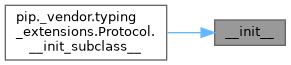
Referenced by Protocol.__init_subclass__().
Member Function Documentation
◆ body()
| str body | ( | self | ) |
Return a summary of me for display under the heading.

This default implementation simply prints a description of the
triggering requirement.

:param req: The InstallRequirement that provoked this error, with
    its link already populated by the resolver's _populate_link().
Reimplemented from HashError.
Definition at line 536 of file exceptions.py.
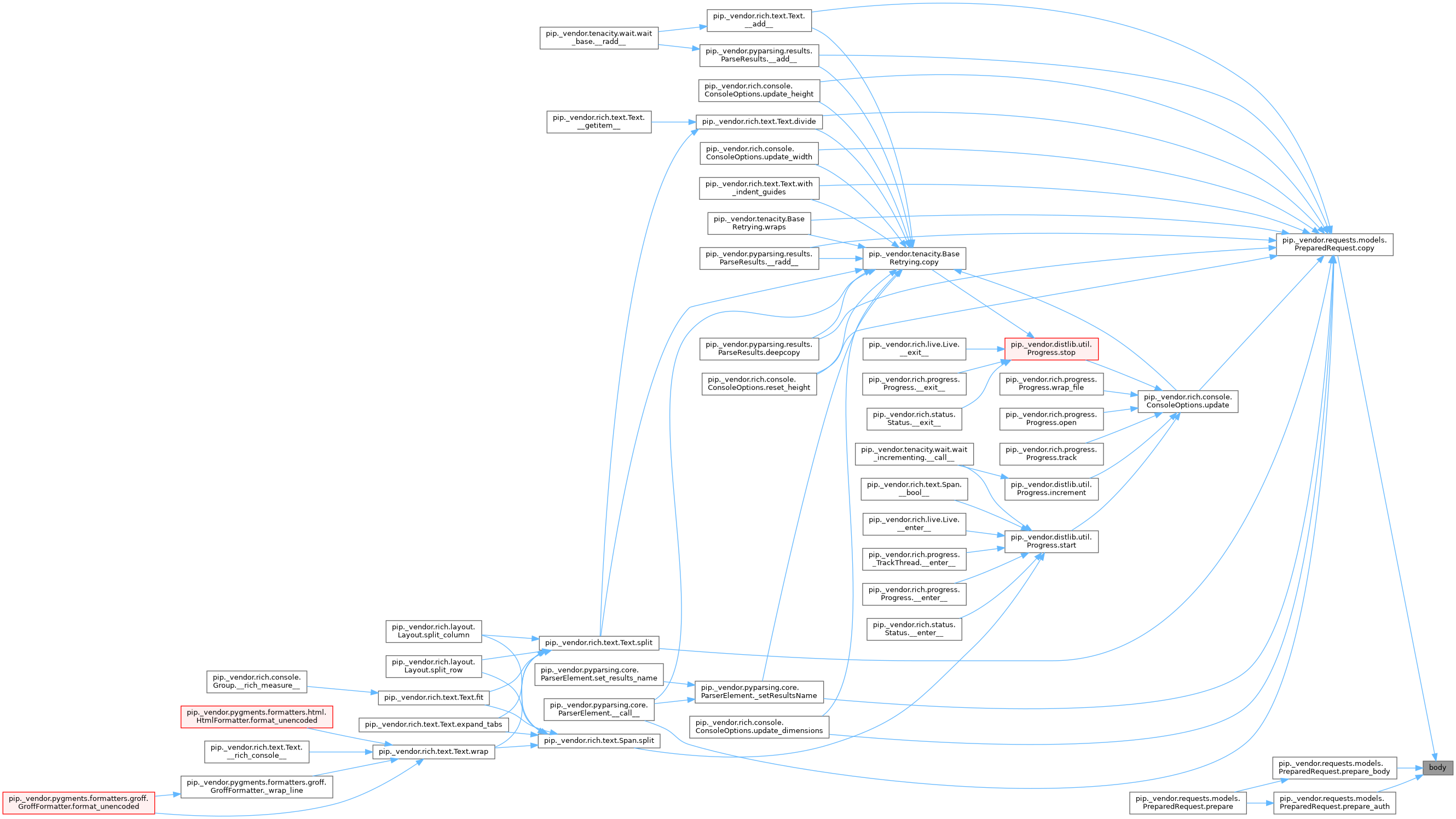
Referenced by PreparedRequest.copy(), PreparedRequest.prepare_auth(), and PreparedRequest.prepare_body().
Field Documentation
◆ gotten_hash
| gotten_hash |
Definition at line 534 of file exceptions.py.
◆ head
|
static |
Definition at line 519 of file exceptions.py.
◆ order
|
static |
Definition at line 518 of file exceptions.py.
◆ req
| req |
Definition at line 550 of file exceptions.py.
Referenced by FrozenRequirement.__str__(), InstallRequirement.__str__(), SourceDistribution._get_build_requires_editable(), SourceDistribution._get_build_requires_wheel(), SourceDistribution._install_build_reqs(), SourceDistribution._prepare_build_backend(), SourceDistribution._raise_conflicts(), SourceDistribution._raise_missing_reqs(), InstallRequirement._set_requirement(), InstallRequirement.assert_source_matches_version(), InstallRequirement.check_if_exists(), InstallRequirement.ensure_build_location(), InstallRequirement.from_path(), InstalledDistribution.get_metadata_distribution(), SourceDistribution.get_metadata_distribution(), WheelDistribution.get_metadata_distribution(), InstallRequirement.name(), SourceDistribution.prepare_distribution_metadata(), InstallRequirement.specifier(), InstallRequirement.uninstall(), and InstallRequirement.warn_on_mismatching_name().
The documentation for this class was generated from the following file:
- /home/liwuen/projects_dev/pqc-engineering-ssec-23/venv/lib/python3.12/site-packages/pip/_internal/exceptions.py