Loading...
Searching...
No Matches
pip._vendor.rich.syntax Namespace Reference
Data Structures | |
| class | _SyntaxHighlightRange |
| class | ANSISyntaxTheme |
| class | PygmentsSyntaxTheme |
| class | Syntax |
| class | SyntaxTheme |
Functions | |
| Optional[int] | _get_code_index_for_syntax_position (Sequence[int] newlines_offsets, SyntaxPosition position) |
Variables | |
| TokenType = Tuple[str, ...] | |
| str | WINDOWS = "Windows" |
| str | DEFAULT_THEME = "monokai" |
| dict | ANSI_LIGHT |
| dict | ANSI_DARK |
| dict | RICH_SYNTAX_THEMES = {"ansi_light": ANSI_LIGHT, "ansi_dark": ANSI_DARK} |
| int | NUMBERS_COLUMN_DEFAULT_PADDING = 2 |
| SyntaxPosition = Tuple[int, int] | |
| parser | |
| metavar | |
| help | |
| dest | |
| action | |
| default | |
| type | |
| int | |
| args = parser.parse_args() | |
| console = Console(force_terminal=args.force_color, width=args.width) | |
| code = sys.stdin.read() | |
| syntax | |
| soft_wrap | |
Function Documentation
◆ _get_code_index_for_syntax_position()
|
protected |
Returns the index of the code string for the given positions.

Args:
    newlines_offsets (Sequence[int]): The offset of each newline character found in the code snippet.
    position (SyntaxPosition): The position to search for.

Returns:
    Optional[int]: The index of the code string for this position, or `None`
        if the given position's line number is out of range (if it's the column that is out of range
        we silently clamp its value so that it reaches the end of the line)
Definition at line 804 of file syntax.py.
806) -> Optional[int]:
807 """
808 Returns the index of the code string for the given positions.
809
810 Args:
811 newlines_offsets (Sequence[int]): The offset of each newline character found in the code snippet.
812 position (SyntaxPosition): The position to search for.
813
814 Returns:
815 Optional[int]: The index of the code string for this position, or `None`
816 if the given position's line number is out of range (if it's the column that is out of range
817 we silently clamp its value so that it reaches the end of the line)
818 """
819 lines_count = len(newlines_offsets)
820
821 line_number, column_index = position
823 return None # `line_number` is out of range
824 line_index = line_number - 1
825 line_length = newlines_offsets[line_index + 1] - newlines_offsets[line_index] - 1
826 # If `column_index` is out of range: let's silently clamp it:
827 column_index = min(line_length, column_index)
828 return newlines_offsets[line_index] + column_index
829
830
References i.
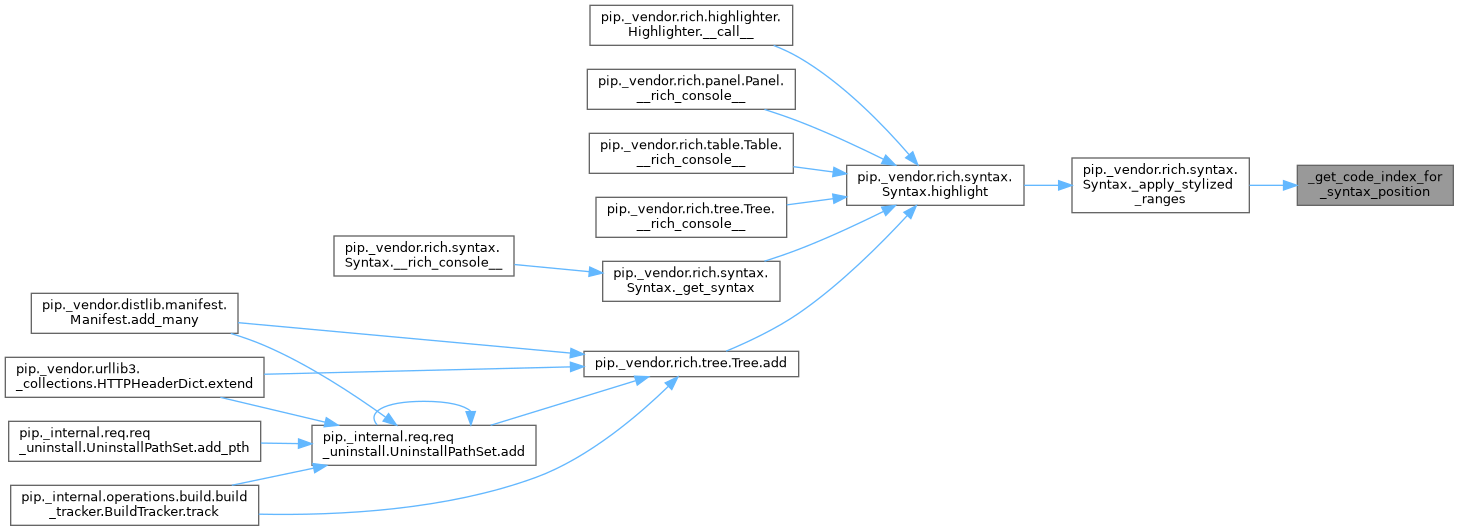
Referenced by Syntax._apply_stylized_ranges().
Here is the caller graph for this function:
Variable Documentation
◆ action
◆ ANSI_DARK
| dict ANSI_DARK |
Initial value:
1= {
2 Token: Style(),
3 Whitespace: Style(color="bright_black"),
4 Comment: Style(dim=True),
6 Keyword: Style(color="bright_blue"),
19 String: Style(color="yellow"),
20 Number: Style(color="bright_blue"),
27 Error: Style(color="red", underline=True),
28}
◆ ANSI_LIGHT
| dict ANSI_LIGHT |
Initial value:
1= {
2 Token: Style(),
3 Whitespace: Style(color="white"),
4 Comment: Style(dim=True),
6 Keyword: Style(color="blue"),
19 String: Style(color="yellow"),
20 Number: Style(color="blue"),
27 Error: Style(color="red", underline=True),
28}
◆ args
◆ code
◆ console
| console = Console(force_terminal=args.force_color, width=args.width) |
◆ default
◆ DEFAULT_THEME
◆ dest
◆ help
◆ int
◆ metavar
◆ NUMBERS_COLUMN_DEFAULT_PADDING
◆ parser
| parser |
Initial value:
◆ RICH_SYNTAX_THEMES
| dict RICH_SYNTAX_THEMES = {"ansi_light": ANSI_LIGHT, "ansi_dark": ANSI_DARK} |
◆ soft_wrap
◆ syntax
| syntax |
Initial value:
1= Syntax(
2 code=code,
3 lexer=args.lexer_name,
4 line_numbers=args.line_numbers,
5 word_wrap=args.word_wrap,
6 theme=args.theme,
7 background_color=args.background_color,
8 indent_guides=args.indent_guides,
9 padding=args.padding,
10 highlight_lines={args.highlight_line},
11 )